Research paper
Technical argument and framework
Read the full research draft, theoretical foundations, architecture, governance mechanisms, limitations, and implementation examples.
Canonical publication hub
reflector presents a framework for governing recursive AI-assisted software engineering through scoped agents, human alignment checkpoints, reflective audits, and milestone synchronization.
Three reading surfaces
Each edition remains a native Reflector artifact with a stable root-level PDF alias.
Research paper
Read the full research draft, theoretical foundations, architecture, governance mechanisms, limitations, and implementation examples.
Visual companion
Move through Reflector’s key ideas as a fourteen-page visual narrative designed to complement—not replace—the technical paper.
Print edition
Download the print treatment while keeping the digital magazine and its canonical source pages unchanged.
System map
The paper’s architecture overview connects agents, governance checkpoints, audits, and synchronized milestones.
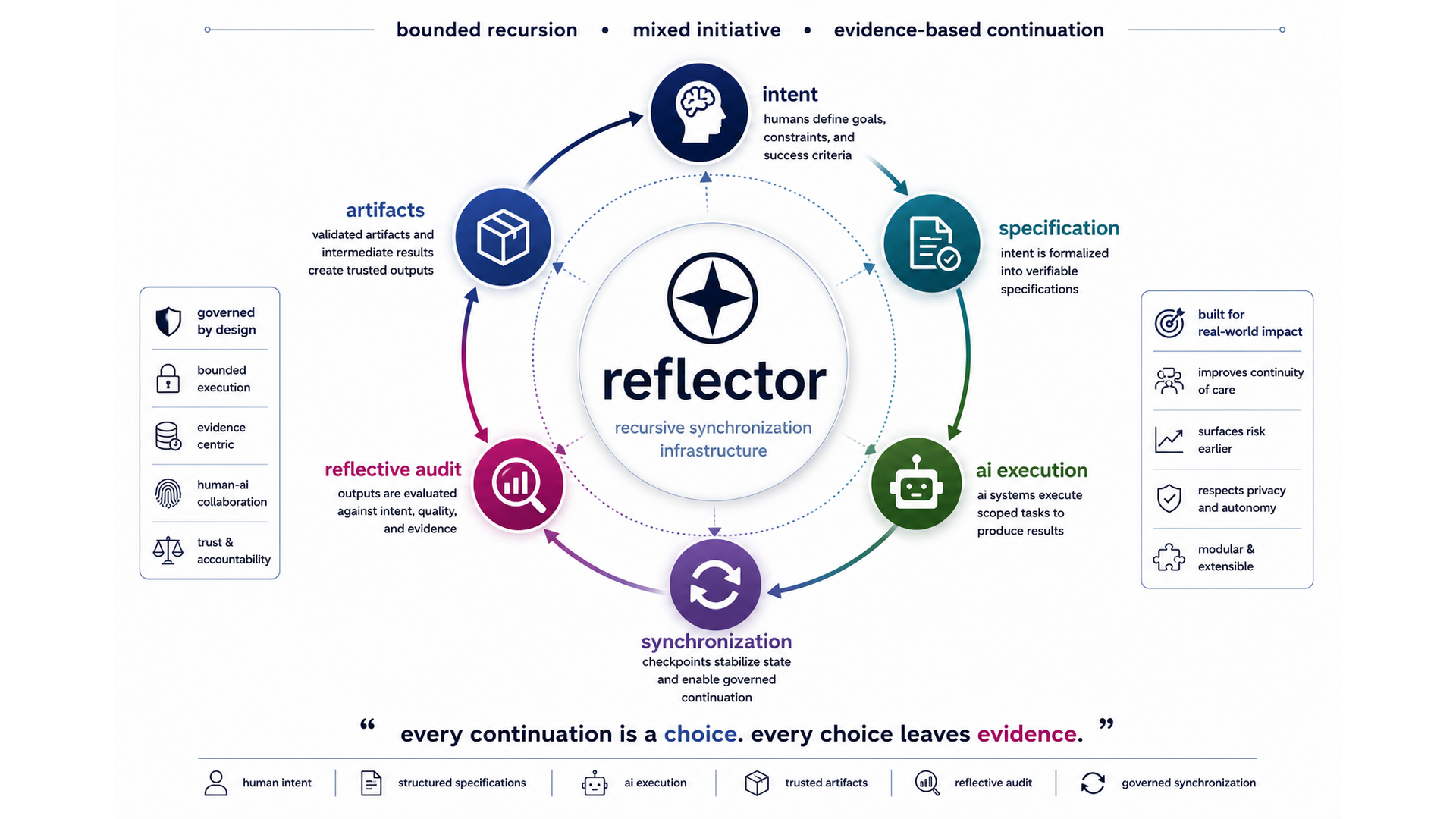
Reflector treats recursive development as a system to govern, not merely a loop to accelerate. Human checkpoints, invariant-aware audits, and milestone gates provide places to compare machine activity with the project’s intended state.
Abstract preview
Recursive AI-augmented software engineering introduces development systems in which autonomous agents generate, evaluate, and refine artifacts inside iterative feedback loops. Without explicit governance boundaries, those systems can drift away from human-defined objectives. Reflector defines structured contracts that keep autonomy scoped, observable, auditable, and synchronized with human intent.
The paper is a released draft. Its claims, status, DOI, version, and artifacts are preserved through the canonical publication manifest and release history.
Visual companion
The magazine translates the paper’s structure into a compact, visual reading path.

Fourteen full-page compositions follow recursive drift, synchronization, distributed cognition, governance, and the Reflector framework. The magazine retains its own native build while sharing the paper’s publication identity.